segunda-feira, 7 de dezembro de 2009

Qual foi o torneio mais forte de todos os tempos?

Retirado do site Chessbase.com.

07.12.2009 – The Tal Memorial this year in Moscow? It has been billed as such, but it all depends on how you evaluate such events. If you correct for rating inflation, and especially if you consider the world ranking of the participants, other tournaments easily outstrip this one. Very plausibly AVRO 1938 was the strongest – or at least the most elite, since players #1-8 were present. Jeff Sonas explains.

What was the strongest tournament of all time?

By Jeff Sonas

As with most of the "greatest-ever" debates, there are many ways to answer this question. The simplest answer is to compare the average FIDE rating of the participants in each tournament. That is how a tournament's "Category" is calculated, with 25-point intervals. Thus if the average rating is 2751-2775 it's a "Category 21" tournament; if the average rating is 2726-2750, it's a "Category 20" tournament, and so on.

The 2009 Tal Memorial in Moscow, recently won by Vladimir Kramnik, was a Category 21 tournament, and I don't believe there has ever been a Category 22 tournament. Thus by this approach, the 2009 Tal Memorial would be in a tie for the strongest tournament of all time. However, I do not place much emphasis on "Category" as a measure of tournament strength, mostly because of the large amount of rating inflation that has taken place in the past 25 years. Recent tournaments will look unusually strong by this measure. There must be a more sophisticated way to measure tournament strength.

There is also the problem that official FIDE ratings have only been around since about 1970, yet there were important chess tournaments going back more than a century before then. You can't calculate the strength of a tournament if there are no ratings available! But fortunately we do have the Chessmetrics historical ratings that provide month-by-month ratings from January 2005 all the way back to January of 1843. I haven't calculated new Chessmetrics ratings since January 2005, so for this current analysis, I just used FIDE ratings for the period from January 2005 to the present.

Nevertheless, in order to really assess which were the "strongest" tournaments of all time, you need a method that is completely immune to the effects of rating inflation. Thus I have decided to avoid using ratings directly, and instead to use players' world rankings (e.g. #1 in the world, #7 in the world, etc.) at the time they played in the tournament. This should hopefully eliminate any problems caused by rating inflation.

Ten years ago I developed a simple trick for calculating a Category-like number, using just the world rankings (not ratings) of top ten players in a tournament. I called this alternate number the tournament's "Class", and it was designed to be in the same magnitude as Category (at least for what Category meant ten years ago). Here is the calculation:

  • A tournament gets 4 points for each participant ranked #1 or #2 in the world.
  • A tournament gets 3 points for each participant ranked #3 or #4 in the world.
  • A tournament gets 2 points for each participant ranked #5 or #6 in the world.
  • A tournament gets 1 point for each participant ranked #7, #8, #9, or #10.

Thus the theoretical maximum, if a tournament included all ten players in the top-ten, would be a Class of 22. There has never been a Class 22 tournament; the ten all-time strongest tournaments by this measure have ranged from Class 19 through Class 21:


Tournament

Class

Top-10 Participation

Missing Top-10 Player(s)

#1

Vienna, 1882

21

#1, #2, #3, #4, #5, #6, #7, #8, #10

#9 S.Rosenthal

#2

Linares, 1993

21

#1, #2, #3, #4, #5, #6, #7, #8, #10

#9 N.Short

#3

Nottingham, 1936

20

#1, #2, #3, #4, #5, #6, #7, #8

#9 A.Lilienthal #10 P.Keres

#4

AVRO, 1938

20

#1, #2, #3, #4, #5, #6, #7, #8

#9 E.Eliskases #10 V.Pirc

#5

Linares, 1992

20

#1, #2, #3, #4, #5, #6, #7, #8

#9 M.Gurevich #10 A.Shirov

#6

Wijk aan Zee 2001

20

#1, #2, #3, #4, #5, #6, #7, #8

#9 E.Bareev #10 B.Gelfand

#7

London, 1883

19

#1, #2, #3, #4, #5, #6, #7

#8 L.Paulsen #9 V.Hruby #10 A.Wittek

#8

Wijk aan Zee 1999

19

#1, #2, #3, #4, #5, #6, #7

#8 M.Adams #9 A.Karpov #10 N.Short

#9

Linares, 1994

19

#1, #2, #3, #4, #5, #7, #8, #9

#6 V.Salov #10 N.Short

#10

Hastings, 1895

19

#1, #2, #3, #4, #6, #7, #8, #9

#5 P.Lipke #10 J.Showalter

As you can see, there have been six tournaments that had the eight top players in the world, and two of those also had the #10 player (but not the #9 player). Thus the two highest-Class tournaments of all time were Vienna 1882 and Linares 1993, both Class 21. As a tiebreaker, I would give the nod to Vienna 1882 because it also included World Champion Wilhelm Steinitz, who was inactive on the rating list (having not played in six years) and thus not a member of the top ten.

I have previously used the Class calculation to identify the "super-tournaments" throughout chess history, referring to any tournament having a Class of 15 or better. There have been 57 such tournaments, including seven during the current decade (2000 through 2009). The only decade having more super-tournaments was the previous decade (1990 through 1999), which had thirteen. Here are those seven tournaments from the current decade (2000 through 2009):


Tournament

Class

Top-10 Participation

#6

Wijk aan Zee, 2001

20

#1, #2, #3, #4, #5, #6, #7, #8

#25

Corus A, 2005

17

#2, #3, #4, #5, #6, #7, #8, #9

#27

Linares, 2000

16

#1, #2, #3, #4, #5

#29

Corus A, 2008

16

#1, #2, #3, #6, #8, #9, #10

#35

Tal Memorial, 2009

16

#2, #3, #4, #5, #7, #8, #9, #10

#39

Linares, 2005

15

#1, #2, #3, #5, #6

#41

Wijk aan Zee, 2000

15

#1, #2, #3, #5, #7, #9

However, this is not the end of the story. The above approach places the most emphasis on how many top-ten players participated in a tournament, especially top-six players, but there is no penalty if the tournament includes one or more lower-rated players. In fact, from that list of the ten tournaments from history having Class 19+, all but one of them (AVRO 1938) included at least one participant who wasn't even ranked in the top-50 in the world. This is a real problem with the above methodology, since I think a lot of people mean "most elite" when they are talking about the "strongest" tournaments.

So, how can we measure the "most elite" tournament, using only world rank and not directly using ratings? I would say that however many players a tournament has, if they are all taken exactly from the top of the rating list, then it is a perfectly elite tournament. And it should be possible to come up with a formula to measure how close each tournament came to being perfectly elite.

Las Palmas 1996 is frequently cited as being the most elite tournament of all time, supposedly including the top six players and nobody else. However, this does not appear to be true. From the July 1996 FIDE rating list, we find that Vassily Ivanchuk (lowest-rated of the six players at Las Palmas) was #7 on the rating list, with Gata Kamsky (who did not play at Las Palmas) 15 points ahead of him at #6. Perhaps the "live FIDE ratings" at the time would have had Ivanchuk higher up and Kamsky down at #7, but of course those are not available and we wouldn't want to use them even if they were.

Similarly, my Chessmetrics historical ratings for 01-Dec-1996 (right before the tournament) also have Kamsky at #6 on the list, half a rating point ahead of #7-ranked Las Palmas participant Veselin Topalov. So it turns out the Las Palmas 1996 was not perfectly elite. Very very close, but not quite. The only tournament in history that was perfectly elite was AVRO 1938, which had the top eight players from the 01-Nov-1938 Chessmetrics rating list, and nobody else in the tournament.

To continue this analysis, let's look at the recent ten-player Tal Memorial tournament. An "ideal" ten-player tournament would have players ranked #1, #2, #3, …, #9, #10. If you add up those ranks, you get 1+2+3+…+9+10=55. Instead, the Tal Memorial included #12 and #13, and did not include #1 or #6. So for that tournament, when you add up the ranks, you get 2+3+4+…+10+12+13=73. Dividing 55 by 73 gives 0.75, and by my simple formula, that tells us the tournament was "75% of ideal".

We can do this for all the tournaments in history, and unsurprisingly we find AVRO 1938 on the top of the list, and Las Palmas 1996 at #2 on the list. You may find a few surprises lower down. And it turns out that the recent Tal Memorial shows up as the seventh-most-elite tournament of all time, and the most elite tournament in more than ten years.


Tournament

%ideal

players

"Non-ideal" participant(s)

"Ideal" player(s) missing

#1

AVRO, 1938

100%

8

(none)

(none)

#2

Las Palmas, 1996

95%

6

#7 V.Topalov

#6 G.Kamsky

#3

Linares, 1998

85%

7

#10 P.Svidler

#5 A.Karpov

#4

Zurich Candidates 1953

83%

15

#16 M.Euwe #25 Y.Averbakh

#2 M.Botvinnik #15 A.Tolush

#5

Reggio Emilia, 1991

80%

10

#11 A.Beliavsky #12 A.Khalifman #15 L.Polugaevsky

#6 N.Short #8 E.Bareev #10 A.Jussupow

#6

St. Petersburg 1895

77%

4

#5 H.Pillsbury

#2 S.Tarrasch

#7

Tal Memorial, 2009

75%

10

#12 V.Ivanchuk #13 R.Ponomariov

#1 V.Topalov #6 V.Gashimov

#8

Linares, 1999

75%

8

#17 P.Leko

#5 A.Shirov

#9

Dortmund, 2001

64%

6

#7 M.Adams #12 V.Topalov

#1 G.Kasparov #6 V.Ivanchuk

#10

Budapest Candidates 1950

61%

10

#11 L.Szabo #19 A.Lilienthal #20 S.Flohr

#1 M.Botvinnik #6 R.Fine #8 S.Reshevsky

#11

Corus A, 2008

60%

14

#15 M.Adams #22 J.Polgar #27 P.Eljanov #36 L.van Wely

#4 A.Morozevich #5 P.Svidler #7 A.Shirov #14 S.Karjakin

#12

Bilbao, 2008

60%

6

#7 T.Radjabov #12 L.Aronian

#2 V.Kramnik #3 A.Morozevich

This is certainly an interesting list, and indicates the historical significance of the 2009 Tal Memorial. You will notice that out of all events that lacked the top-ranked player in the world, it qualifies as the most "elite" tournament ever, since it brought together 10 of the next 12 players below #1 Veselin Topalov, with no participants worse than #13 in the world.

Normally you might think it would be one of the first five FIDE World Championship Candidates Final tournaments (1950 through 1962) that would qualify for the odd distinction as the "most-elite" tournament that also lacked the top-ranked player in the world. In fact, while the 1950 Budapest tournament did indeed attempt to bring together the next ten players after top-rated Mikhail Botvinnik, you can see from the above table that more top-ten-players were omitted than in the recent Tal Memorial, and Budapest also included two participants well below #13 in the world, so on both counts the Tal Memorial seems to have been more elite. And my historical ratings did not consider World Champion Botvinnik to be the top-rated player in the world at the time of the 1953, 1956, 1959, or 1962 Candidates Finals, so in fact each of those tournament did include the top-ranked player in the world (S.Reshevsky in 1953, V.Smyslov in 1956, M.Tal in 1959, and T.Petrosian in 1962) according to Chessmetrics.

In any event, one could legitimately argue that it is a serious omission for an "elite" tournament to be lacking the very top player in the world. It is true that my simple formula would penalize a tournament as much for including the #19 player instead of the #9 player, as it would for including the #11 player instead of the #1 player, and that probably isn't quite right. Instead of a pattern like 1+2+3+…+9+10, we could use the reciprocal of the world rank, and thus it would be 1.00+0.50+0.33+0.25…+0.11+0.10 instead. This rewards the events more that have full participation from the top handful from the rating list, and at the other end it doesn't care as much whether you have #20 or #30. This modification brings Las Palmas 1996 even closer to the "ideal" AVRO 1938. By this final measure, here are the 12 most "elite" tournaments of all time:

See the complete table on: http://www.chessbase.com/newsdetail.asp?newsid=5956

Clearly it would be very hard to argue with the choice of AVRO, 1938 as the strongest, most elite tournament of all time, the perfect blend of top-ten participation and elite selectivity. After that tournament, it's not as clear; it really depends on whether you think a "strong" tournament means it has a host of top-ten players, or if you mean it is an extremely elite event. It is difficult for one tournament to accomplish provide both. Either way, the above data should hopefully be a good resource for the next time you want to argue about what was the strongest tournament of all time!

Copyright Chessmetrics


Euwe, Smyslov, Keres, Botvinnik and Reshevsky at the AVRO 1938 tournament

Cross tables of the twelve top tournaments

See the complete tables on: http://www.chessbase.com/newsdetail.asp?newsid=5956

domingo, 6 de dezembro de 2009

Calendário de Eventos enxadrísticos - Dezembro 2009

Retirado do site Clubedexadrez.com.br.

Calendário de dezembro

Atualizado em 05/12 às 15h09 (horário de verão) - prossegue hoje, com a sexta rodada, a Final do Campeonato Brasileiro Absoluto em Americana e termina em Mendes o Festival Sulamericano da Juventude - jornal "O Estado de São Paulo" está sob censura há 128 dias - ótimo domingo a todos!

1 a 3: Torneio Condomínio Colonial Residence - fechado, jogadores locais e de Conceição do Rio Verde/MG - em andamento

2 a 11: Final do Campeonato Brasileiro - premiação: R$10.000,00 ($3.000,00 ao campeão) - Americana - SP - em andamento, resultados do sábado: quarta rodada - MF Carlos Alberto Barreto Filho 0 x 1 GM Giovanni Vescovi, GM Alexandr Fier 0,5 x 0,5 MI Everaldo Matsuura, Máximo Iack Macedo 1 x 0 MF Roberto Junio Molina, GM André Diamant 1 x 0 MI Jorge Humberto Bittencourt, GM Rafael Leitão 0,5 x 0,5 GM Gilberto Milos Júnior e MI Krikor Sevag Mekhitarian 1 x 0 MF Yago Santiago; quinta rodada - Santiago (1,5) 0,5 x 0,5 (1) Barreto Filho, Milos(3) 0,5 x 0,5 Mekhitarian(vice-líder com 3,5), Bittencourt(1,5) 0,5 x 0,5 Leitão(3), Molina(2,5) 1 x 0 Diamant(2,5), Matsuura(2,5) 1 x 0 Macedo(2,5) e Vescovi(líder com 4,5) 0,5 x 0,5 Fier(2,5). Neste domingo, sexta rodada às 15h30 com Barreto Filho x Fier, Macedo x Vescovi, Diamant x Matsuura, Leitão x Molina, Mekhitarian x Bittencourt e Santiago x Milos

2 a 11: 6º Festival Sulamericano da Juventude - sub 18 a sub 8 - Mendes - RJ - em andamento

3 a 6: Aberto de Fim de Ano Tabuleiro Cultural - São Paulo - em andamento, 12 jogadores. Edmundo Aoyama lidera com 5 em 6. Na sétima e antepenúltima rodada, puxou ( e como puxou...) Expedito Santana, 11º com 1,5

4 a 6: Campeonato Municipal Absoluto - Carazinho - RS - em andamento

5 e 6: Etapa de Resende do Circuito dos Regionais do Interior Fluminense - classificatório para os campeonatos Carioca ou do Interior, conforme a filiação - premiação: R$1.000,00 ($400,00 ao campeão) - em andamento

5 e 6: 6ª Etapa Classificatoria do Campeonato Absoluto Alto Paranaíba e Triangulo Mineiro de Xadrez Pensado 2009 - valendo 15 vagas para a Semifinal - premiação: R$300,00 (R$100,00 para o Campeão) - Araxá - em andamento

5: Aberto 25º Aniversário do Clube de Xadrez Peão na Sétima - premiação: R$1.000,00 ($300,00 ao campeão) - Capão da Canoa - RS - encerrado

5: Competição enxadrística dos Jogos Estudantis da Rede Pública da Bahia/Etapa Barreiras - categorias A (nascidos entre 92 e 94) e B ( entre 95 e 97) - encerrado

5: Torneio Copercampos - 4 emparceiramentos distintos: Absoluto, Até 16 Anos, Até 12 Anos e Até 8 Anos - Campos Novos - PR - encerrado

6: Etapa do Circuito Paulista Dinâmico/8ª do Circuito Centro-Oeste Paulista, denominada Mikhail Nekhemievich Tal - premiação: R$630,00 ($200,00 ao campeão) - Bauru - em andamento

6: Etapa classificatória dos campeonatos paranaenses Absoluto e Feminino - Toledo - em andamento

7 a 19: 2º IRT Tabuleiro Cultural - fechado, 12 jogadores - São Paulo

7 a 19: 2º IRT HiperChess - fechado, 12 jogadores - São Paulo

11 a 20: IRT Cidade dos Azulejos - fechado, 10 jogadores - São Luis

12 e 13: Final do Campeonato Goiano Absoluto - Quartas-de-final e Semifinal - Goiânia

12 e 13: Campeonato Carioca

12 e 13: 2º Aberto Três Rios - premiação: R$1.300,00 ($500,00 ao campeão) - RJ

13: Torneio Mensal de Xadrez do SESC Interlagos - inscrições gratuitas e antecipadas pelo e-mail xadrez@interlagos.sescsp.org.br até o dia 12/12 as 13 horas - São Paulo

13: Final do 2º Grand-Prix Sesc Interlagos - disputam o Troféu Sesc Interlagos os 6 melhores pontuadores do ano: Cassius Silva, Italo Vale, Valdinei Fialho, Armen Proudian, Vinicius Saito e Fernando Lacerda - São Paulo

13: 3º Torneio de Confraternização - Carapicuíba - SP

16 a 20: Torneio Fide 35 Anos da Fundação da Associação Leopoldinense de Xadrez/Alex - premiação: R$2.000,00 ($800,00 ao campeão) - Rio de Janeiro

12: Torneio de Confraternização do Clube de Xadrez Mogi das Cruzes - premiação: R$700,00 ($200,00 ao campeão) - SP

16 a 31: Torneio 35 Anos da Fundação da Associação Leopoldinense de Xadrez/Alex - Rio de Janeiro

18 a 20: 2º Aberto Balneário do Sol - Bonito - MS

19 e 20: Final do Campeonato Goiano Absoluto - match final de 4 partidas - Goiânia

19 e 20: 4º Memorial Hercílio Ermel/Homenagem ao GM Jaime Sunye Neto/Campeonato Paranaense Aberto de Rápidas - premiação: R$3.000,00 ($1.000,00 ao campeão) - Londrina

19 e 20: Campeonato Fluminense do Interior

19: 4º Memorial Hercílio Ermel/Homenagem ao GM Jaime Sunye Neto/Campeonato Paranaense Aberto Relâmpago - Londrina

19: 37º Torneio Papai Noel GXBG - lata de panetone, de bom tamanho e procedência, e garrafa de espumante (sim, espumante, pois champagne só se for francesa e produzida na região da Champagne) ao campeão - São Paulo

19: Torneio AABB Rio - Finish - Rio de Janeiro

20: Etapa final fechada do Circuito Solidário GXBG/Casa Amarela de Santo Amaro - SP 28 a 31: Magistral de Natal Praça Seca Xadrez Clube - RJ


competição inaugural de 2010:


5 a 10: IRT Final do Campeonato Mineiro Absoluto 2009 - 12 finalistas - premiação: R$600,00 ($200,00 ao campeão) - Belo Horizonte

sexta-feira, 4 de dezembro de 2009

Your judgement, please - Pt. 29

Retirado do site Chessbase.com.

A knight on a weakened central square...
04.12.2009 – ... usually means a strong positional trump, however, sometimes this alone is not enough to win the game. Here Black was facing the question whether closing the queenside with 20...b3 21.a3 (diagram) would be beneficial for him. What do you think? A) this enhances Black's spacial superiority, but doesn't yield him anything concrete; B) a powerful continuation, considerably increasing his positional advantage; C) not good, White has one worry less and will be able to successfully defend himself in the centre and on the kingside.
The solution is here, but first ponder over it with a larger version of the diagram.

Position after 20...b3 21.a3


sexta-feira, 27 de novembro de 2009

Your judgement, please - Pt. 28

Retirado do site Chessbase.com.

Su valoración, por favor
Avanzando peones por delante de su propio rey, ya no es ninguna excepción en las modernas líneas de aperturas (en este caso se trata de la Variante Ruy Lopez/Moller 5...Ac5). No obstante, siempre se debería actuar con mucha cautela. En este ejemplo, las negras se deben plantear la cuestión si podrán ganar más terreno con 18...g4, intenntando ganar el peón central de las blancas d4. ¿Qué opina Ud.? A) Las negras alcanzan la ventaja, y gracias al fuerte Cf5 mantiene el control firmemente. B) El será devuelto, la posición ha sido debilitada demasiado. C) Las blancas podrán igualar con un juego preciso. La solución está aquí, pero antes de mirarla le sugerimos que reflexione sobre el problema

¿Qué tal les parece 18...g4?

quinta-feira, 26 de novembro de 2009

Ambiente aberto de Xadrez Online

Retirado do blog Vida Geek.

O Xadrez Livre é um ambiente aberto de ensino e aprendizagem de xadrez criado para servir como apoio ao projeto de ensino de xadrez nas escolas brasileiras.

Mas não é só ensino e aprendizagem que interessam por lá, há também o Ambiente de Jogo (http://xadrezlivre.c3sl.ufpr.br) , onde os usuários podem jogar contra robôs ou entre si - há uma média de 100 usuários conectados, mas já aconteceram picos com 300 jogadores. São 3 níveis de robôs (fácil, intermediário e difícil) que já completaram 100 mil partidas. O robô difícil, por exemplo, já jogou 21.136 partidas e dessas, ganhou 19.668.

Além disso, o Xadrez Livre é composto ainda por outras duas ferramentas:

  • o Módulo de Aprendizagem, que tem como objetivo auxiliar o estudo das regras e aspectos introdutórios do jogo de Xadrez, disponibilizando explicações sobre o jogo e suas regras e exercícios de fixação da aprendizagem;
  • e o Gerenciador de Torneios, uma ferramenta para o planejamento e o acompanhamento de competições de Xadrez.

Para os desenvolvedores que quiserem contribuir o código fonte está em http://git.c3sl.ufpr.br/gitweb. O servidor é um componente Jabber baseado em XMPP/Jabber, com interface Javascript e Ajax.

Pra quem quiser entrar em contato com a equipe – formada por bolsistas do Centro de Computação Científica e Software Livre (C3SL) da UFPR – escreva para xadrez-devel em c3sl ponto ufpr ponto br.

quarta-feira, 25 de novembro de 2009

Your judgement, please - Pt. 27

Retirado do blog Chessbase.com.

Selected attacking games
25.11.2009 – Games full of tactical ups and downs and mating motifs rightly charm every chess fan, and so it will come as no surprise that a successful attack on the king always represents a dainty morsel for all chess lovers. We have selected and annotated two attractive attacking games from the Russia Cup in Saint Petersburg. In the first of them (diagram) we see how Ian Nepomniachtchi sets about an uncastled Sicilian king. In the second game, a Ruy Lopez, Alexei Fedorov managed to reduce to rubble the castled position of the black monarch. IM Michael Kopylov for ChessBaseMagazine Online.

Position after 19.h6!

domingo, 22 de novembro de 2009

Your judgement, please - Pt. 26

Retirado do site Chessbase.com.

Su valoración, por favor
Una hueste de peones pasados contra un ataque a lo largo de las columnas g y f fue lo que se presenció en la partida que hoy ofrecemos, en la que se cambiaron damas tras 30...f4 31.Dxg5 Txg5, pero las negras se las arreglaron para colocar en la balanza la doble amenaza 32...fxe3 y ...f3. ¿Cuál es su comentario en esa situación? A) Los peones pasados aún no están suficientemente adelantados, así que ganan las negras; B) con el mejor juego unas tablas posicionales son la consecuencia lógica; C) las blancas salen victoriosas. Tiene la solución aquí, pero antes de mirarla le sugerimos que reflexione sobre el problema

Juegan las blancas tras 31... Txg5

sexta-feira, 20 de novembro de 2009

World Blitz Championship: closeup video footage

Retirado do site Chessbase.com.

20.11.2009 – Some watched it live in the GUM mall in Moscow. You probably followed the action on Playchess, perhaps with webcam images from the official site running as well (they had a strange two-minute lag to the game moves). Now you have a chance to see highlights of the World Blitz Championship close up in video with a JavaScript replay board. A unique experience – you don't want to miss it!


World Blitz Championship – final pictorial report

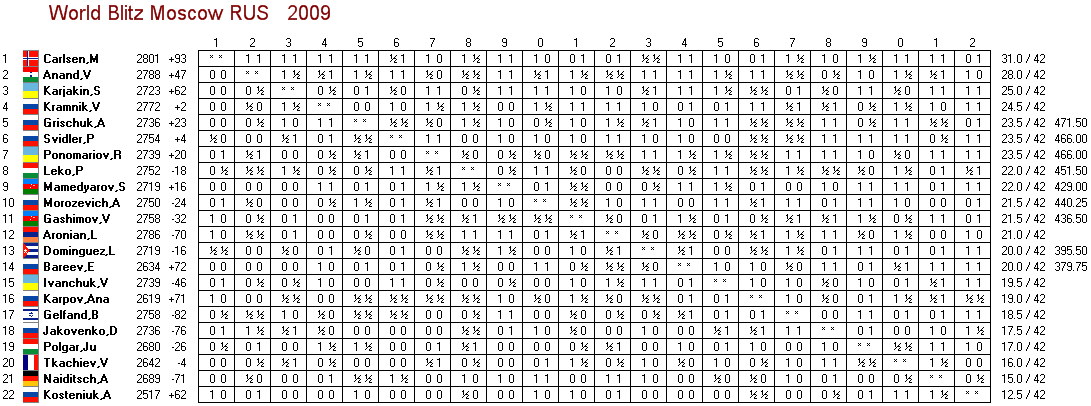
This event was held on November 16, 17 and 18 in the showroom of the Red Square mall GUM. Time controls were three minutes for the whole game + two seconds increment per move. The event was a 22-player double round-robin, i.e. it had a total of 42 rounds, which were played on three consecutive days. The participants include the players from the Tal Memorial, plus twelve invitees. The average rating was 2718 – quite remarkable for an evernt with so many players.

Videos of the Blitz games in Moscow

Posted on YouTube by Eugene Potemkin and Sergey Sorlkhtin

Below are six videos we have selected for you. As a special service you can watch them together with the replayable games on our JavaScript board. Try it out: start the video and click on the notation or the replay buttons to follow the moves on the graphic chessboard. Note that you can pause the video at any stage by pressing the Space bar on your computer keyboard. Pressing it again will restart the video.

If you just want to watch the videos you can use the players below:


World Blitz Championship – the players enter for the round


Round 17 games between Shakh Mamedyarov and Vladimir Kramnik


Round 28: Magnus Carlsen vs Peter Svidler. This video was posted by
Bumblebee1607 – there are more on his YouTube channel.


The zeitnot phase of the round 30 game between Carlsen and Grischuk


Ten-minute video of the full round 34 game Carlsen vs Karjakin


The final phase of the round 37 game Mamedyarov vs Ivanchuk

Final standings (after 42 rounds)

Click to get a full table (with ratings, performance and tiebreaks)


Links

sexta-feira, 13 de novembro de 2009

Your judgement, please - Pt. 25

Retirado do site Chessbase.com.

White squares and diagonals...
13.11.2009 – ... were the issue in this position where the first player had sacrificed an exchange to occupy the 7th rank and drive the black king to g6. Yet after 25...Rad8 an idea was required. What do you think, is the best continuation a move...
A) with the queen;
B) with a bishop;
C) or with a pawn?

The solution is here, but first ponder over it with a larger version of the diagram.

White to move after 25...Rad8

quinta-feira, 12 de novembro de 2009

Your judgement, please - Pt. 24

Retirado do site Chessbase.com.

Knight in the corner
11.11.2009 – "A knight on the rim is dim" - there is no aphorism which is known more widely to amateur players than this one. And although there are more than enough exceptions to this rule, the phrase naturally is also fully justified. All the more so when the case involves not just a knight on the edge of the board, but that rarely spotted example of the species: a knight in the corner. Recently, one such example caused Ivan Cheparinov all sorts of problems, when the sad-looking steed was corralled in the corner with the help of a bishop. GM Karsten Müller analyses the ending Cheparinov-Caruana for ChessBase Magazine Online.

Position after 45... Ba5